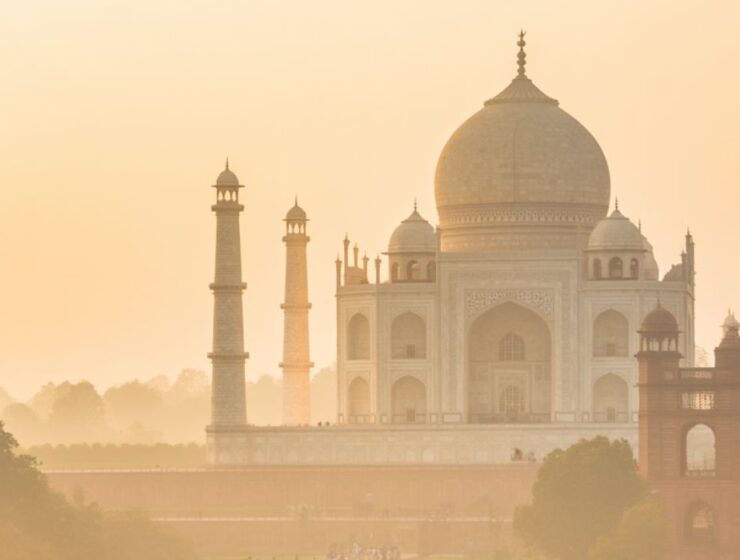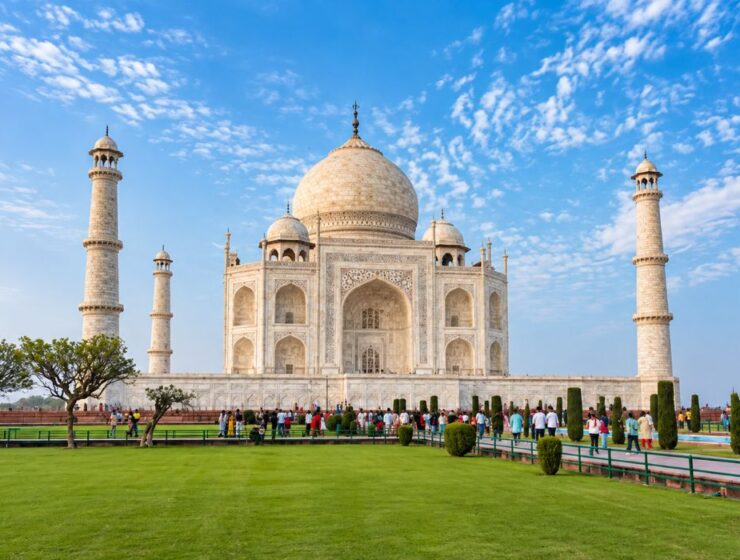

Akbar built an entire city from red sandstone. Then he abandoned it after 15 years. No battle, no invasion — just no water. Fatehpur Sikri became a UNESCO World Heritage Site in 1986.
It is one of the best preserved Mughal cities in India. Most tourists skip it because they’re rushing back to Delhi, and most of those tourists regret it later.
I’ve taken hundreds of Emperor Holidays clients here since 2009. Here’s exactly what you need to know.
Quick Facts
| Detail | Information |
|---|---|
| Location | 40 km from Agra |
| Timings | Sunrise to sunset |
| Jama Masjid closed | Fridays (prayers only) |
| Foreigner ticket | ₹610 |
| Indian ticket | ₹50 |
| Time needed | 2-2.5 hours |
| Drive time | 1 hour each way |
| UNESCO since | 1986 |
| Best for | Overnight visitors |
What Is Fatehpur Sikri — The Story
Akbar built this capital between 1569 and 1585. He came here to meet Sufi saint Salim Chishti, who predicted Akbar would finally have a son. That son was Jahangir — named after the saint.
The city was magnificent: palaces, courts, mosques, markets. Everything a Mughal emperor needed. Then the water ran out. Fifteen thousand people left, and Akbar moved the capital back to Agra. Nobody ever rebuilt here.
Walking through Fatehpur Sikri feels like the residents left last week. That’s what makes it different from other monuments.
What to See Inside — Top Highlights
1. Buland Darwaza
Fifty-four meters high — one of the tallest gateways in the world. Akbar built this after defeating Gujarat in 1572. You can see it from two kilometers away.
Walk under it and notice how the acoustics change. That was intentional. Listen for the monkeys screeching from the walls — they’ve taken over the upper arches.
Time needed: 15 minutes
2. Jama Masjid
Still a functioning mosque. Friday prayers happen here with hundreds of locals. The courtyard is among the largest of any Mughal mosque.
Dress code reminder — cover shoulders and knees. Remove shoes before entering the prayer hall. Someone watches them for a few rupees.
Note for Friday visits: The mosque area is closed to tourists during prayer hours (approx 12 PM – 2 PM). The rest of the complex remains open.
Time needed: 20 minutes
3. Tomb of Salim Chishti
Inside Jama Masjid courtyard. This isn’t just a tourist attraction — it’s an active pilgrimage site. Women tie red threads on the marble screens inside the tomb, praying for children. You’ll see people of all religions here, asking for blessings or giving thanks.
Don’t rush through this one. Sit for five minutes and watch the locals. This is what living heritage looks like.
Time needed: 15-20 minutes
4. Panch Mahal
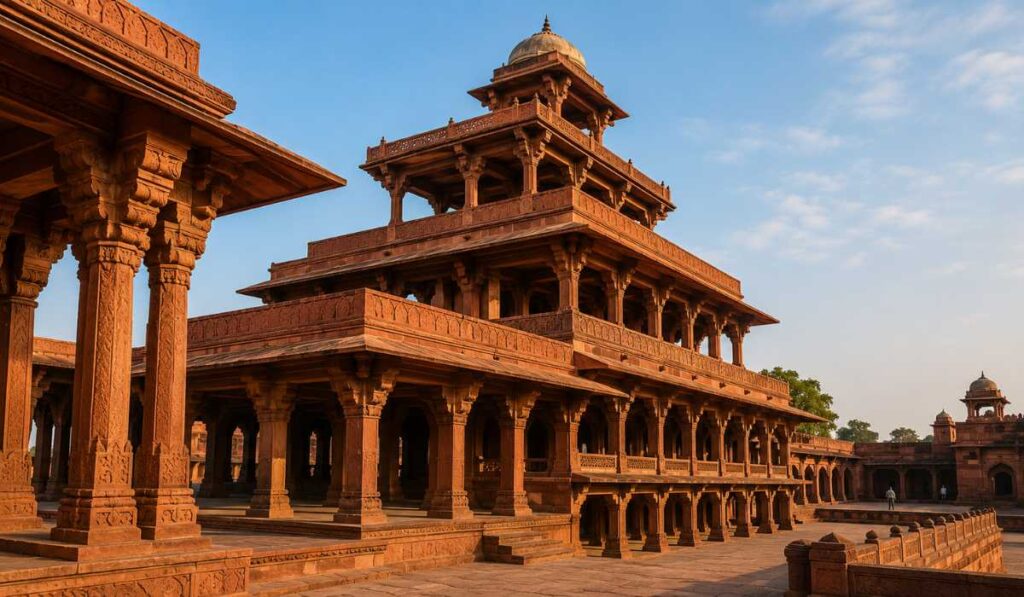
Five stories, zero walls. Each floor gets smaller as you go up. Only the ground floor has solid walls — upper floors were screened. The queens used this for evening entertainment.
The natural cooling system worked so well that even in April, the top floor has breeze. In summer, put your hand on the stone — it stays cool hours after sunset. One hundred seventy-six columns, no two with the same carving.
Time needed: 15 minutes
5. Diwan-i-Khas
This is the most unusual building in Fatehpur Sikri: a single central pillar with a flat platform on top, supported by brackets spreading in all directions. Akbar sat on that platform while his advisors sat on four bridges connecting to the pillar.
Nobody knows exactly what they discussed here. Some say religious debates, others say state secrets. No other Mughal building looks like this.
Time needed: 15 minutes
6. Anup Talao
A decorative tank between Diwan-i-Khas and Diwan-i-Aam. Musicians sat on the small island in the middle. The water created natural acoustics — sound carried perfectly to Akbar’s seat.
Palace of Jodha Bai is nearby, with Hindu design mixed into Islamic architecture — a clear sign of Akbar’s policy.
Time needed: 10 minutes
Is Fatehpur Sikri Worth Visiting — Honest Answer
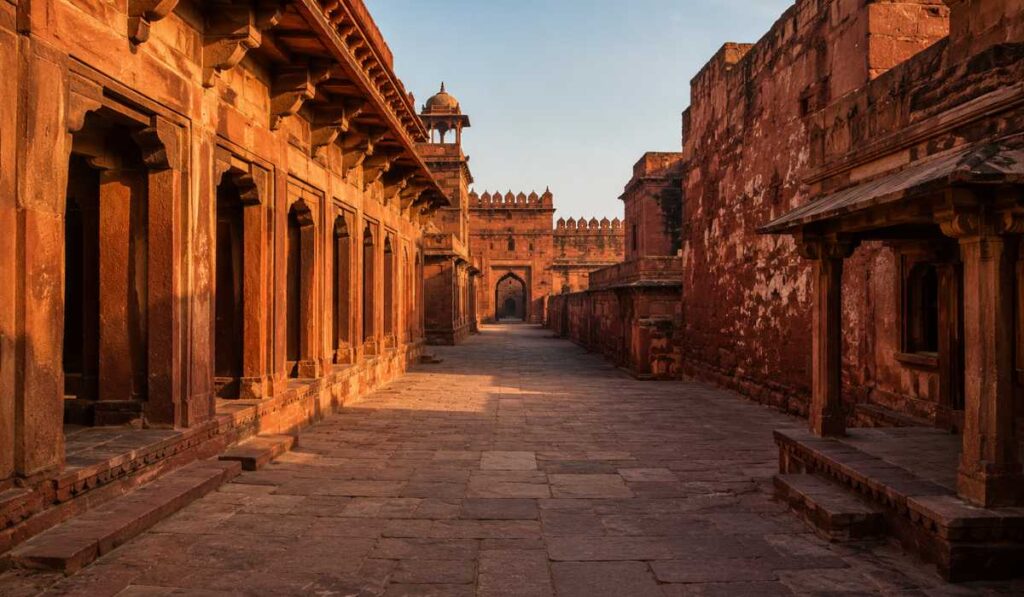
Who SHOULD visit:
→ History and architecture lovers — you’ll spend hours here
→ First-time India visitors — this is unlike anything else
→ Overnight Agra travelers — this fits perfectly (overnight Agra tour includes it)
→ Anyone with 6+ hours in Agra after seeing the Taj Mahal
Who should SKIP:
→ Same-day Delhi-Agra travelers (read this carefully)
→ Anyone on a tight schedule who hates rushing
→ Families with young children who tire easily
Here’s the truth — most tourists try to do Delhi, Agra, and Fatehpur Sikri in one day. That’s a mistake. Same day trip from Agra? Skip Fatehpur Sikri. Overnight in Agra? Do NOT skip it.
How to Combine with Agra Visit
Option 1: Same Day — Not Recommended
Leave Agra at 7 AM → drive 1 hour → reach Fatehpur Sikri by 8 AM → spend 2.5 hours → back in Agra by 12 PM. Then Taj Mahal and Agra Fort complete guide in the afternoon.
Technically possible, but most travelers find it exhausting — you’re rushing between three major sites without enjoying any of them. We do not recommend this. Be honest with your schedule.
Option 2: Overnight Tour
Day 1: Pickup from Delhi in morning → Agra Fort → Itimad-ud-Daulah (Baby Taj) → Mehtab Bagh viewpoint for sunset view of Taj Mahal → overnight in Agra
Day 2: Sunrise at Taj Mahal (best time to visit Taj Mahal) → breakfast → drive to Fatehpur Sikri → explore for 2.5 hours → continue to Delhi
Fatehpur Sikri sits directly on the Agra-Delhi highway. No extra detour. This is how it’s meant to be experienced. Our overnight tour includes Fatehpur Sikri on day two. Most of our clients say this ended up being their unexpected highlight of the trip — quieter than the Taj Mahal, more immersive than Agra Fort.
Fatehpur Sikri Entry Fee & Timings
Entry fee: Foreigner ₹610, Indian ₹50, SAARC/BIMSTEC ₹610. Video camera fee extra if you carry one.
Timings: Sunrise to sunset daily. Last entry one hour before sunset.
Jama Masjid access: The mosque is closed to tourists on Fridays during prayer hours (roughly 12 PM to 2 PM). The rest of the complex stays open. Plan accordingly.
Audio guide costs ₹100 — worth every rupee. The site has minimal signboards, and the audio guide explains what you’re looking at.
Licensed guide costs ₹300-500. Guides here are good — many have been working since the 1990s. Ask for one at the ticket counter.
What to carry: Water bottle, hat, sunscreen, walking shoes. No food inside the monument area — eat before or after. The stone gets hot by 11 AM, and your feet will thank you for shoes.
Security: Same as Taj Mahal. No tripods, no selfie sticks, no large bags. Lockers available outside.
Best time to visit Fatehpur Sikri: October to March. Summers (April-June) are brutal — 45°C is normal. Morning hours before 10 AM or after 3 PM work best. The light at sunset turns the sandstone orange-gold — worth staying for.
Pro Tips — What Most Guides Won’t Tell You
The parking shuttle confusion: Your car will stop at the main parking lot, about 1.5 km from the entrance. Buses and shared jeeps charge ₹10-20 per person to reach the ticket area. You can walk if you want — but it’s uphill and dusty.
Things to avoid: Before you reach the ticket counter, men will approach offering guide services. Some are fine, some are not. Official licensed guides work inside near the ticket window — that’s where you find the reliable ones. Also, never pay anyone who claims the site is “closed” and offers to take you to a “better” nearby monument. Walk past confidently.
The “abandoned city” beyond the main complex: Most tourists see Buland Darwaza, Jama Masjid, and the palaces — then leave. But the residential area extends for another kilometer beyond the main gate. No restoration, no crowds — just empty streets and houses. Ask your guide to take you there if you have extra time.
Best photo timing: Diwan-i-Khas gets direct morning light from 8-9:30 AM. Panch Mahal photographs best in late afternoon when the sun hits the columns from the side. Buland Darwaza works any time — it’s massive enough to dominate any light.
How to Reach Fatehpur Sikri from Agra & Delhi
From Agra: 40 kilometers, 1 hour by car. Take NH19 (Agra-Jaipur highway) then NH21. Taxi cost ₹800-1200 round trip depending on waiting time.
From Delhi: Natural stop on the drive back from Agra, about 3.5 hours from Delhi if you go directly. Most of our same day Taj Mahal tour by car skips Fatehpur Sikri for timing reasons — but the overnight tour includes it perfectly. Read our Delhi to Agra travel options guide for full details.
Public transport: Buses leave from Agra’s Idgah Bus Stand every 30 minutes. Trains run from Agra Cantonment to Fatehpur Sikri station, but the station is 2 km from the site. Car is better.
Book Your Agra Tour
Emperor Holidays has operated private tours from Agra since 2009. Our guides Aamir and Azhar handle every booking personally. 343+ TripAdvisor reviews and counting.
Fatehpur Sikri is included in our overnight tour at no extra cost. Most clients tell us this was the surprise highlight — more peaceful than the Taj Mahal, more immersive than Agra Fort.
→ Overnight Tour — Starts from $80 (includes Fatehpur Sikri on Day 2)
→ Same Day Car Tour — Starts from $120 (Fatehpur Sikri not included — we’re honest about this)
→ Same Day Train Tour — Starts from $290
→ Taj Mahal Sunrise Tour — Starts from $285
→ Agra Walking Tour — Starts from $100
→ View All Tours – all Taj Mahal tours
More from Emperor Holidays
- Things to do in Agra — beyond the Taj
- Agra Fort complete guide — 2 hours well spent
- Best time to visit Taj Mahal — crowd timing matters
- Same day Taj Mahal tour by car guide — if you only have one day
FAQ — Fatehpur Sikri
1. Is Fatehpur Sikri worth visiting if I have limited time?
No. If you only have 4-5 hours in Agra, skip it and focus on Taj Mahal. If you have a full day plus overnight, absolutely worth it. Honest answer from someone who does this daily.
2. How far is Fatehpur Sikri from Agra?
40 kilometers. One hour by car in normal traffic, plus 15-20 minutes during peak hours. The drive is on a good highway — you’ll see rural Uttar Pradesh along the way.
3. Is half day enough for Fatehpur Sikri?
Yes. Half day (4 hours including travel) is fine. Full day (6 hours) is better if you want to explore the abandoned city area outside the main complex. Most tourists don’t go there — your guide can show you if you have time.
4. Is a guide necessary at Fatehpur Sikri?
Not necessary but recommended. Audio guide is the minimum. The site has almost no explanatory boards. Without guidance, you’re just walking through empty stone buildings wondering what each one was for.
5. What is the best time to visit Fatehpur Sikri?
Morning — 8 AM to 10 AM. Cooler temperatures, better light for photos, fewer crowds. Avoid Friday if you want to enter Jama Masjid during midday — but the rest of the complex is fine.