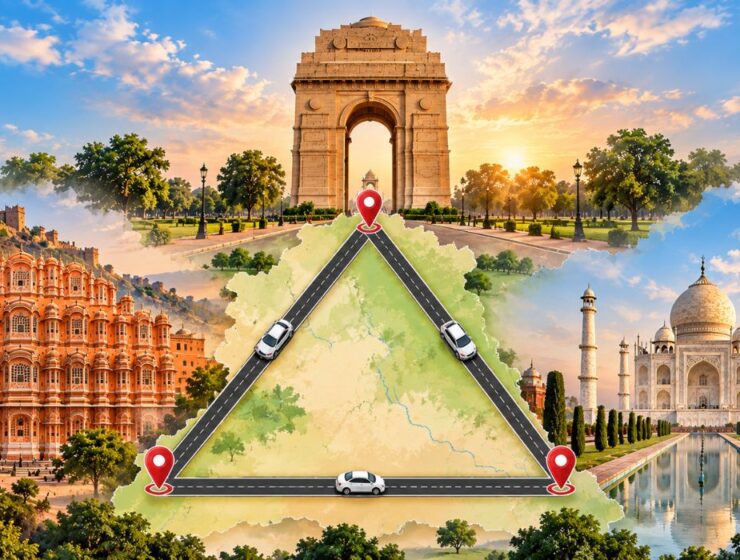

The Golden Triangle connects Delhi, Agra, and Jaipur in a loop that covers roughly 750 kilometers. It is India’s most popular tourist circuit for good reason.
First-time visitors to India often start here. The route offers a concentrated dose of Indian history, architecture, and culture without requiring weeks of travel time. Roads and rail connections between these three cities are reliable. Tourist infrastructure is well developed.
This guide explains everything you need to know before booking a Golden Triangle tour India trip. You will learn about realistic time requirements, what to see in each city, budget expectations, seasonal challenges, and common mistakes to avoid.
Golden Triangle Tour at a Glance
| Factor | Details |
|---|---|
| Route | Delhi → Agra → Jaipur → Delhi |
| Recommended Duration | 5–7 Days |
| Best Time to Visit | October–March |
| Total Distance | Approx. 750 km |
| Main Attractions | Taj Mahal, Amber Fort, Red Fort, Qutub Minar, City Palace |
| Ideal For | First-time visitors to India |
What Is the Golden Triangle?
The Golden Triangle is a tourist circuit forming a rough triangle on the map. The three vertices are Delhi, Agra, and Jaipur.
Delhi → Agra → Jaipur → Delhi
| Route | Distance |
|---|---|
| Delhi to Agra | 230 km |
| Agra to Jaipur | 240 km |
| Jaipur to Delhi | 280 km |
Each city has a distinct personality. Understanding these differences helps you plan better.
Delhi is the political and historical capital. The city has served as the seat of power for multiple empires, including the Mughals and the British. Old Delhi shows narrow lanes, bustling markets, and Mughal-era architecture. New Delhi features wide boulevards, government buildings, and colonial-era design.
Agra represents Mughal heritage at its peak. The city sits on the Yamuna river and was the capital of the Mughal Empire under emperors Akbar, Jahangir, and Shah Jahan. While the Taj Mahal draws most visitors, Agra contains several other important Mughal monuments.
Jaipur introduces you to Rajput culture and Rajasthan’s royal history. The city is known as the Pink City, a reference to the terracotta-pink color applied to its old city buildings. Jaipur’s forts, palaces, and bazaars offer a different architectural language compared to Delhi and Agra.
How Many Days Do You Need?
Let me be honest with you. The number of days you allocate will determine whether you enjoy the trip or feel exhausted.
5 Days
A 5-day Golden Triangle tour is possible but rushed. You will spend significant time in transit and see only the main monuments. Day one in Delhi, day two traveling to Agra and visiting the Taj Mahal, day three driving to Jaipur, day four sightseeing in Jaipur, day five returning to Delhi. This works for travelers on tight schedules but expect long days and limited flexibility.
Travelers with limited vacation time often prefer a Golden Triangle Tour 5 Days itinerary.
6 Days
A 6-day Golden Triangle tour is the sweet spot for most visitors. You get two nights in each city or a more relaxed distribution. Two days in Delhi, one night in Agra, two nights in Jaipur works well. You can visit monuments without rushing and have time to explore markets or take breaks.
If you have the flexibility, the Golden Triangle Tour 6 Days option gives you the best balance of coverage and comfort.
7–8 Days
Extra days improve the experience considerably. You can add a day trip from Jaipur to places like Abhaneri stepwell or sampling. You can also slow down the pace, which matters during summer heat or peak crowds.
Most travelers booking Golden Triangle tour packages choose 6 days as the standard option. Five days works for those who prioritize efficiency over comfort.
What to See in Delhi
Delhi requires two days to see properly. Trying to cover it in one day means missing most of the city.
Red Fort – This massive red sandstone fortress was the main residence of Mughal emperors for 200 years. Plan at least two hours. The sound and light show in the evening is worth attending.
Jama Masjid – One of India’s largest mosques, built by Shah Jahan. The courtyard holds 25,000 people. Climb the southern minaret for a view of Old Delhi. Cover your shoulders and knees.
Chandni Chowk – The main street of Old Delhi. It is crowded, loud, and chaotic. That is exactly why you should experience it. Take a rickshaw ride through the narrow lanes. Visit early morning or late afternoon to avoid peak crowds.
Local tip: By 11 AM, Chandni Chowk becomes almost impassable for rickshaws. Go before 9 AM if you want to actually move through the lanes rather than sit in a traffic jam.
Qutub Minar – A 73-meter tall minaret from the 12th century. The tower and surrounding complex show early Indo-Islamic architecture. Plan one hour.
Humayun’s Tomb – This Persian-style garden tomb inspired the design of the Taj Mahal. It is quieter than other monuments. Visit in late afternoon for good light and fewer people.
India Gate – A war memorial arch in the center of New Delhi. Best visited in the evening when the area fills with local families. The surrounding lawns are good for a short break.
Most travelers stay in South Delhi or near Connaught Place. Both areas offer good access to monuments and transport links.
What to See in Agra
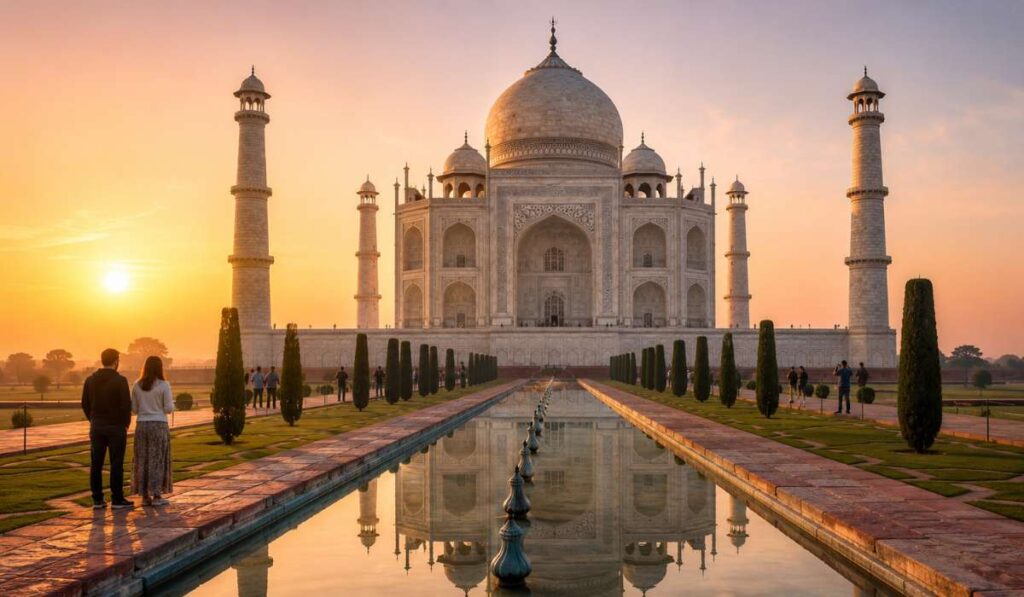
Agra has one main attraction and several supporting ones. Do not make the mistake of visiting only the Taj Mahal.
Taj Mahal – Visit at sunrise. The gates open about 30 minutes before sunrise. Be in line at least 45 minutes before opening. The first hour has fewer crowds and better light. Avoid midday, especially in summer. Friday is closed for prayers.
Local tip: By 9 AM, the queue at the east gate can stretch well beyond the entrance area. The south gate is slightly less crowded, but the west gate (reserved for foreign tourists) is the fastest entrance. Many guides quietly recommend the west gate for this reason.
Agra Fort – This red sandstone fort is 500 meters from the Taj Mahal. Emperor Shah Jahan spent his final years imprisoned here, watching the Taj Mahal from a small balcony. The fort contains palaces, mosques, and audience halls. Plan two hours. Visit in late afternoon when the light hits the marble buildings.
Local tip: Most tourists rush through Agra Fort in 45 minutes. That is a mistake. The angled light after 3 PM turns the marble surfaces golden. The view of the Taj Mahal from the fort’s windows is also best at this time.
Mehtab Bagh – A garden complex directly across the river from the Taj Mahal. Sunset views here are excellent. The Taj Mahal appears in the distance, framed by the river. This is where photographers go for wide shots without crowds.
Local tip: The river level between Mehtab Bagh and the Taj Mahal varies seasonally. From October to February, you can sometimes walk on the sandbanks for an unobstructed reflection shot. Ask a local boatman about current conditions.
Local tip: The Shah Jahan story connects these monuments. He built the Taj Mahal for his wife Mumtaz Mahal. His son Aurangzeb overthrew him and imprisoned him in Agra Fort. From his prison window, Shah Jahan could see the Taj Mahal every day until his death.
For detailed monument guides, we have resources on Taj Mahal entry tickets, best visiting times, Agra Fort history, and Mehtab Bagh photography tips.
What to See in Jaipur
Jaipur is Rajasthan’s capital and a city of forts, palaces, and markets. One full day is the minimum. Two days are better.
Amber Fort – Located 11 kilometers outside Jaipur on a hillside. The fort combines Hindu and Mughal architecture. The Sheesh Mahal (Mirror Palace) inside is extraordinary. You can walk up, take a jeep, or hire an elephant (though animal welfare concerns exist, so jeeps are recommended). Morning is best before heat and crowds build. Plan three hours.
Local tip: The walk up to Amber Fort takes 20 minutes at a slow pace. Many tourists take the jeep without realizing the path offers better photo angles of the fort walls. Walk up and take the jeep down – that is what local guides do.
City Palace – Still home to Jaipur’s royal family. The palace complex includes museums, courtyards, and halls. The private audience hall holds two massive silver vessels, the largest silver objects in the world. Plan two hours.
Hawa Mahal – The Palace of Winds is a five-story facade with 953 small windows. Royal women once watched street processions through these windows without being seen. Photograph from the street outside. The interior is less interesting. Go early morning for good light and fewer tourists.
Local tip: The best Hawa Mahal photo spot is actually the café across the street on the upper floor. Ask any rickshaw driver – they all know the one. Go before 8 AM to avoid the tour bus crowds.
Jantar Mantar – A collection of 19 astronomical instruments built in the 18th century. The instruments are surprisingly accurate. The large sundial still tells local time. One hour is sufficient.
Shopping – Johari Bazaar sells jewelry and gemstones. Bapu Bazaar offers textiles, leather goods, and souvenirs. Tripolia Bazaar is known for brassware and carpets. Bargaining is expected. Start at half the quoted price.
Local tip: Shopkeepers in Jaipur often close for lunch between 1 PM and 2:30 PM, especially in July and August. Plan your shopping either before 1 PM or after 3 PM to avoid locked shutters.
Golden Triangle Budget Guide
Here are realistic daily costs per person. INR estimates are for local reference. USD estimates are for international planning.
Accommodation (per night)
| Category | INR | USD |
|---|---|---|
| Budget (clean guesthouse, basic room) | ₹800–1,500 | $10–18 |
| Mid-range (3-star hotel, private bathroom, AC) | ₹2,500–5,000 | $30–60 |
| Luxury (5-star hotel, full services) | ₹8,000–20,000 | $95–240 |
Food (per day)
| Category | INR | USD |
|---|---|---|
| Budget (street food, local restaurants) | ₹300–600 | $3.50–7 |
| Mid-range (restaurants, some hotel meals) | ₹800–1,500 | $9.50–18 |
| Luxury (hotel restaurants, fine dining) | ₹2,000–4,000 | $24–48 |
Transport (between cities)
- Train (sleeper class): ₹300–600 ($3.50–7)
- Train (AC chair car): ₹800–1,200 ($9.50–14)
- Private car with driver (full circuit): ₹12,000–18,000 ($145–215) total
Monument Entry Fees (foreign tourist)
| Monument | INR | USD |
|---|---|---|
| Taj Mahal | ₹1,100 | $13 |
| Agra Fort | ₹650 | $8 |
| Amber Fort | ₹500 | $6 |
| City Palace | ₹700 | $8.50 |
| Qutub Minar | ₹600 | $7 |
| Humayun’s Tomb | ₹600 | $7 |
Total daily budget estimates (excluding international flights)
| Traveler Type | INR per day | USD per day |
|---|---|---|
| Budget traveler | ₹2,000–3,000 | $25–35 |
| Mid-range traveler | ₹5,000–8,000 | $60–95 |
| Luxury traveler | ₹15,000–25,000 | $180–300 |
Best Time to Visit the Golden Triangle
October to November – The best time. Monsoon has ended. Temperatures range from 20–30°C (68–86°F). Skies are clear. Crowds are moderate before peak season starts.
December to January – Cool weather with daytime temperatures around 15–22°C (59–72°F). Nights can drop to 5°C (41°F). Fog is a real problem in Delhi and Agra during these months. Flights and trains face delays. Morning visibility at the Taj Mahal may be poor. If you travel in December or January, schedule monuments for late morning when fog usually lifts.
Local tip: December fog in Delhi can reduce visibility to the point where trains run hours behind schedule. If you travel in winter, build a buffer day into your itinerary.
February to March – Excellent time. Temperatures warm up to 25–30°C (77–86°F). Days are pleasant. This is peak tourist season, so expect crowds at major monuments, especially the Taj Mahal.
April to June – Very hot. Temperatures reach 40–45°C (104–113°F). Sightseeing becomes difficult by midday. Only consider if you handle heat well and plan morning and evening activities with an afternoon break.
July to September – Monsoon season. Rainfall varies year to year. Humidity is high. Some roads may be affected. Fewer tourists and lower prices are advantages, but outdoor sightseeing is less comfortable.
Popular Golden Triangle Extensions
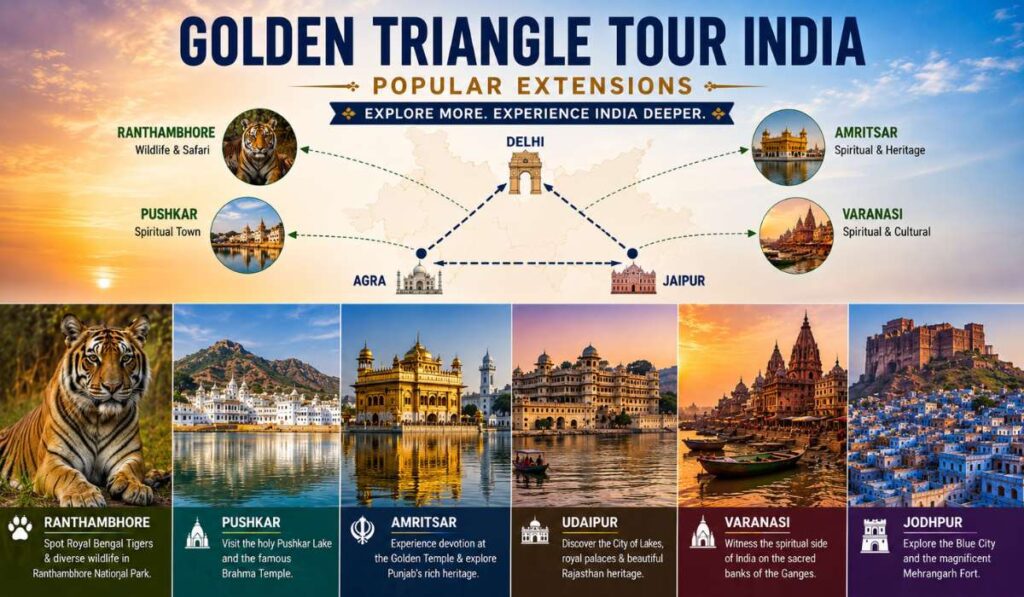
Many travelers add destinations to the classic circuit. Each extension serves different interests.
Golden Triangle with Ranthambore
This extension adds Ranthambore National Park, known for Bengal tigers. Safaris run at sunrise and late afternoon. Tiger sightings are not guaranteed, but the park has a healthy population. Suits wildlife enthusiasts and photographers. Add 2–3 days.
If tigers are on your wish list, the Golden Triangle Tour with Ranthambore is the right fit.
Golden Triangle with Amritsar
Amritsar is home to the Golden Temple, Sikhism’s holiest site. The temple’s gold-leaf exterior and community kitchen (serving 100,000 free meals daily) are remarkable. The Wagah Border ceremony between India and Pakistan happens every evening. Suits those interested in spiritual sites and modern Indian history. Add 2 days.
Travelers who want to experience Sikh culture and the India-Pakistan border should look at the Golden Triangle Tour with Amritsar itinerary.
Golden Triangle with Rajasthan
This extension adds cities like Jodhpur, Udaipur, and Jaisalmer. You experience blue cities, lake palaces, and desert forts. Suits travelers who want deep exposure to Rajputana culture. Duration varies from 10 to 15 days depending on how many cities you include.
For those ready to explore deeper into Rajasthan, the Golden Triangle Tour with Rajasthan route covers the region’s highlights.
Golden Triangle with Khajuraho and Varanasi
Khajuraho is known for its 10th-century temples with intricate erotic sculptures. Varanasi is India’s holiest city on the Ganges river. Evening Ganga aarti ceremonies and morning boat rides are unforgettable. Suits cultural travelers and those interested in India’s spiritual traditions. Add 4–5 days.
Culture-focused travelers often prefer the Golden Triangle Tour with Khajuraho and Varanasi for its depth and variety.
Common Mistakes First-Time Visitors Make
Trying to do everything in 4–5 days – You will spend more time in a car than at monuments. Fatigue leads to poor decisions and less enjoyment.
Visiting the Taj Mahal too late – By 9 AM, crowds are thick. By 10 AM, heat and noise make the experience worse. Sunrise is the only sensible time.
Underestimating travel times – Google Maps shows driving times that assume ideal conditions. Add 30–50 percent for real-world traffic, especially around Delhi and Jaipur.
Ignoring seasonal weather – December fog can cancel trains. April heat can make walking impossible by noon. Check weather patterns before booking.
Overpacking itineraries – Five monuments per day is too many. Two or three major sights per day with breaks for food and rest works better.
Booking non-AC transport in summer – This seems like a budget choice until you spend six hours in 42-degree heat. Pay for AC.
Carrying only large bills – Small vendors, rickshaw drivers, and street food stalls cannot change ₹2,000 notes. Keep ₹100, ₹200, and ₹500 notes.
Forgetting to bargain – Fixed prices do not exist in markets and with independent drivers. Negotiation is expected.
Practical Travel Tips
Transportation – Private car with driver is the most comfortable option between cities. Trains are cheaper but require booking in advance. Buses are not recommended for this circuit.
Guides – Official government-approved guides at the Taj Mahal cost around ₹1,500–2,000 ($18–24) for two hours. They provide historical context and help navigate crowds. Always check identification badges.
Tickets – Buy monument tickets online when possible. The Taj Mahal website allows advance booking. This saves 30–60 minutes waiting in ticket lines.
Cash vs cards – Hotels and large restaurants accept cards. Monuments, markets, taxis, and small shops require cash. ATMs are available in all three cities.
Mobile internet – Buy a local SIM card at Delhi airport. Airtel and Jio have the best coverage on this circuit. A 1.5GB daily plan costs around ₹300–500 ($3.50–6) for a week.
Safety – The Golden Triangle is safe for tourists who exercise normal precautions. Avoid walking alone after 10 PM in unfamiliar areas. Keep valuables in hotel safes. Do not accept food or drinks from strangers.
Clothing – Light cotton in summer, layers in winter. Shoulders and knees must be covered at mosques and some temples. Comfortable walking shoes are essential.
Weather preparation – Carry sunscreen, sunglasses, and a hat from March to June. Bring a jacket and scarf from December to February. A reusable water bottle works everywhere.
Planning Your Golden Triangle Trip
The Golden Triangle is straightforward to plan once you understand the distances, seasonal conditions, and time requirements. Start by deciding how many days you have. Then choose whether you want the classic circuit or an extension to Ranthambore, Rajasthan, Amritsar, Khajuraho, or Varanasi.
Travelers looking to compare different routes can explore the complete range of Golden Triangle Tours, including classic itineraries and extended journeys across North India.
Related Guides
- Taj Mahal Entry Ticket Guide
- Best Time to Visit Taj Mahal
- Agra Fort Complete Guide
- Mehtab Bagh Photography Guide
FAQ
Is the Golden Triangle worth it for first-time visitors?
Yes. The circuit is designed for first-time visitors. Infrastructure is good, distances are manageable, and the concentration of major sights is higher than anywhere else in India.
How many days are ideal?
Six days is the best balance between coverage and comfort. Five days works for tight schedules. Seven or eight days allows a relaxed pace or side trips.
Is the Golden Triangle suitable for solo travelers?
Yes. The Golden Triangle is one of the easiest routes in India for solo travelers. Tourist infrastructure is well developed, major attractions are easy to access, and many visitors choose private transportation or guided tours to simplify logistics.
What is the best way to travel between Delhi, Agra, and Jaipur?
Private car with driver is most comfortable and flexible. The expressway between Delhi and Agra takes three hours. The Agra–Jaipur highway takes four to five hours. Trains are a reliable budget alternative, especially the Gatimaan Express from Delhi to Agra.
Is the Golden Triangle safe for tourists?
Yes. These three cities receive millions of foreign tourists annually. Petty theft and touts are the main concerns, not violent crime. Keep belongings secure, avoid empty streets late at night, and use registered taxis.
Can I customize my itinerary?
Yes. Most travelers customize their Golden Triangle trip by changing the order of cities, adding rest days, or including extensions to places like Ranthambore, Varanasi, or Rajasthan’s other cities.
What is the best month for a Golden Triangle tour?
October and November are generally considered the best months because temperatures are comfortable, skies are usually clear, and visibility at major monuments is good. February and March are also excellent choices for sightseeing. Avoid April through June if you are sensitive to heat.