The first mistake most people make when planning India is treating it like a normal country. They apply the same logic they would use for France or Thailand. They pick a few cities, book some hotels, and assume the rest will work itself out. This approach fails in India because India is not a normal country. It is a subcontinent compressed into a single nation.
Its internal diversity exceeds the differences between many European countries. The languages change. The food changes. The architecture changes. The very texture of daily life changes as you move.
Planning a trip here requires a different kind of thinking. You need strategy, not just a list. You need to think about sequence, momentum, and psychological readiness. This is why the most experienced travelers and the most thoughtful tour designers consistently arrive at the same conclusion: the journey should begin with a Taj Mahal tour.
This is not about following the crowd. It is about understanding how to structure an experience for maximum impact. This article explains the strategic logic behind starting with the Taj Mahal and why it makes your entire trip better.
The Overwhelm Factor: Why India Demands a Cognitive Anchor
India hits you with intensity from the moment you land. The airport in Delhi is modern and efficient, but step outside, and the sensory shift is immediate. The heat, the smell of spices and exhaust, the honking horns, the crowd of people, the subtle but constant pressure of touts—it all arrives at once. For the uninitiated, this creates what psychologists call cognitive load. Your brain is working overtime just to process the environment, leaving less mental energy for decision-making.
This is the Overwhelm Factor. When you combine this immediate sensory assault with the need to plan a multi-city itinerary, the result is often decision paralysis. You freeze, second-guess. You worry that you are making the wrong choices.
A Taj Mahal tour solves this by providing what we call a cognitive anchor. This is a single, clear, non-negotiable reference point that organizes everything else around it. Instead of thinking, “I need to plan two weeks in India,” you think, “I need to get from Delhi to the Taj Mahal, see it properly, and then figure out where to go next.” The task shrinks. The mental load decreases. You regain a sense of control.
This anchoring effect is not just psychological comfort. It is a proven decision-making framework. When humans face overwhelming complexity, we naturally seek a fixed point to orient ourselves. The Taj Mahal serves that function perfectly. It is world-famous. Visually unmistakable. It is located conveniently near the main entry point. The logical fixed point around which a coherent North India itinerary can be built.
The Accessibility Advantage: Delhi-Agra Is India’s Most Reliable Corridor
International flights to North India land in Delhi. This is not a choice; it is a geographic reality. Indira Gandhi International Airport is the primary gateway for the entire northern half of the country. Any strategic itinerary must account for this fact.
The corridor from Delhi to Agra is the most developed and reliable long-distance route in North India. This is not an accident. Millions of visitors book Taj Mahal tours annually, and the infrastructure has grown to meet that demand.
The Yamuna Expressway is a 165-kilometer, six-lane controlled-access highway. It reduces what was once a six-hour ordeal on congested roads to a predictable three to three-and-a-half-hour drive. For the premium traveler, this matters. You are not gambling on road conditions or driver reliability. You are moving along a purpose-built corridor designed for efficiency.
The rail connection is even more precise. The Gatimaan Express is India’s fastest train, completing the Delhi-Agra journey in 100 minutes. It offers clean, air-conditioned carriages, punctual departures, and a stress-free experience. You can leave Delhi after breakfast and be standing before the Taj Mahal before lunch.

This accessibility means that India tour packages can be designed with remarkable flexibility. A traveler arriving on an overnight flight can transfer directly to the train station and experience the Taj on their first day in the country. This immediate immersion creates momentum. You have not spent days adjusting to India in a hotel room. You have arrived and immediately experienced something extraordinary.
Agra as a Soft Landing: Predictability When You Need It Most
Beyond mere accessibility, Agra offers something equally valuable for first-time travelers: operational maturity. The city has been receiving international visitors for decades. Its tourist infrastructure is calibrated to their expectations in ways that less-visited cities cannot match.
The Taj Mahal complex itself operates with a level of organization uncommon in India. Separate queues for foreign tourists move faster. Security procedures, while thorough, are consistent and predictable. Signage is clear. Pathways are maintained. This creates a soft landing ecosystem. Your first major encounter with an Indian tourist site occurs in a relatively controlled environment.
Hotels along Fatehabad Road range from reliable mid-range properties to world-class five-star brands. These establishments understand international standards of cleanliness, service, and communication. You are not taking a gamble on an unknown guesthouse. You are staying in properties designed specifically for visitors like you.
This predictability is not about seeking a sanitized experience. It is about strategic staging. By handling your first days in a well-developed tourist environment, you build competence and confidence. You learn how India works in a context where the margins for error are thinner. When you later venture to less-touristed cities or more remote areas, you carry that competence with you.
Historical Foundation: Learning to Read Mughal India
The Taj Mahal is the final statement of Mughal architecture, but it did not emerge from nothing. It is the culmination of a design language that evolved over more than two centuries. Viewing it first provides an invaluable educational framework.
Consider how we learn any subject. We typically start with the mature expression of an idea and then trace its development backward. Learn calculus after arithmetic. We read advanced novels after children’s books. The mature form provides a reference point that makes earlier forms intelligible.
The Taj Mahal serves this function for Mughal architecture. Its perfect symmetry, its flawless marble inlay, its harmonious proportions establish a standard of excellence. When you later visit earlier sites—Humayun’s Tomb in Delhi, the Agra Fort, Itmad-ud-Daulah’s Tomb—you see them differently. You are not judging them as lesser versions. Understanding them as essential steps in an evolution.
You notice how the red sandstone of the fort conveys imperial power. See the experimental inlay work at the earlier tomb as a prototype. You recognize the Persian influences that would later be refined. The Taj Mahal becomes not just a monument to admire but a key that unlocks the architectural history of an entire empire.
This sequencing transforms your trip from passive sightseeing into active learning. You are not collecting photos. Understanding a narrative. You are seeing how ideas develop, how craftsmanship refines itself, and how an empire expressed its identity through stone.
Psychological Impact: Building Confidence Through a Peak Experience
Every traveler carries a private anxiety before visiting a world-famous landmark. What if it is underwhelming? If the crowds ruin it? What if the smog obscures the view? This anxiety is real, and it can subtly undermine the entire travel experience.
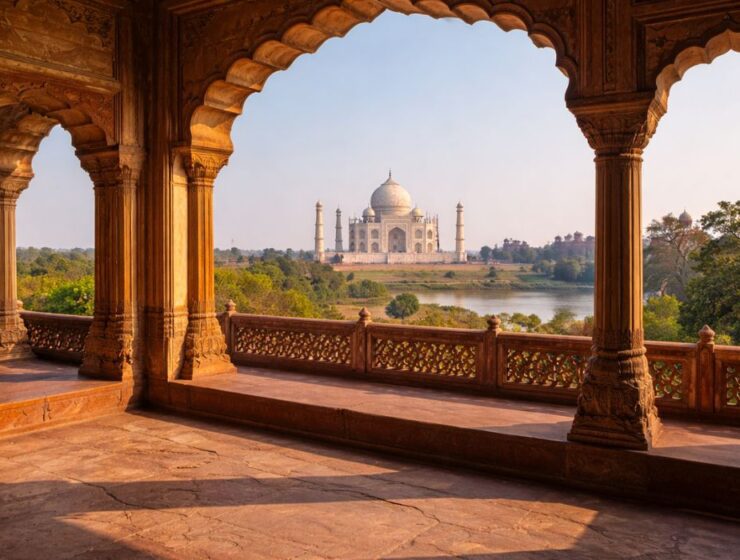
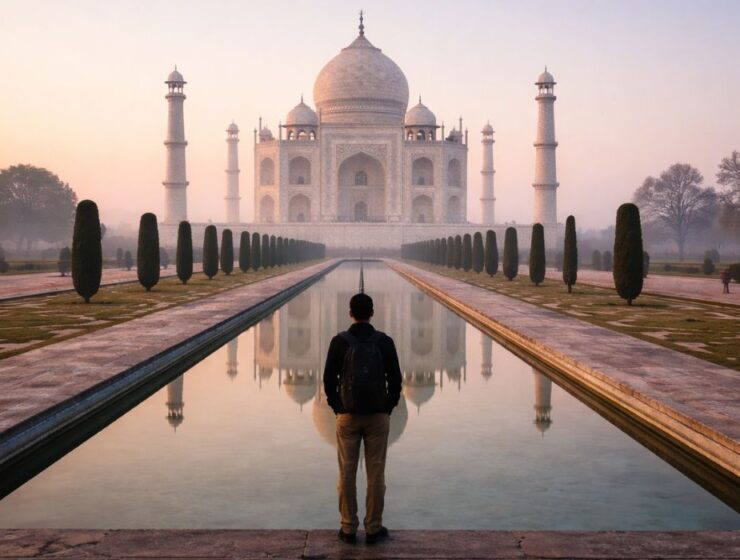
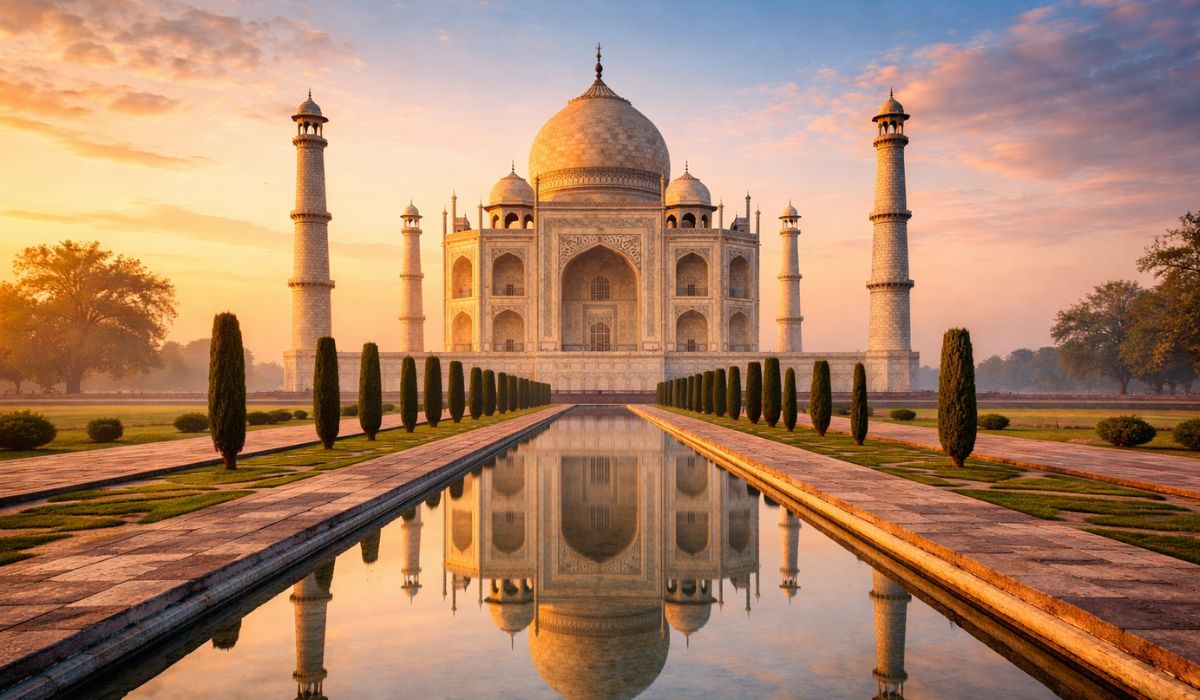
A Taj Mahal Sunrise Tour is the definitive answer to this anxiety. Arriving before dawn requires effort, but that effort is rewarded exponentially. As the sun breaks the horizon, the marble undergoes a transformation that photographs cannot capture. It shifts from cool silver to warm peach to luminous gold. The crowd is thin. The air is still. The mausoleum appears to float above the Yamuna River.
In that moment, the anxiety dissolves. The landmark is real, and it is extraordinary. You have experienced one of the world’s great sights at its absolute best.
This experience creates what psychologists call a peak-end effect. Research shows that people judge experiences largely based on the peak moment and the ending. By placing a powerful peak experience at the very beginning of your journey, you accomplish two things. First, you generate positive momentum. Second, you establish a high reference point that makes subsequent experiences feel richer by comparison.
Having conquered the wonder of the world and found it deeply satisfying, the traveler gains confidence. The next challenge—be it the chaotic bazaars of Jaipur, the ghats of Varanasi, or the backstreets of Old Delhi—no longer seems intimidating. The Taj Mahal serves as proof that the rewards of this journey are worth the effort. It calibrates your expectations upward and primes you for deeper engagement.
Expectation Calibration: Why Starting High Changes Everything
There is a deeper psychological mechanism at work here that deserves explicit attention: expectation calibration. When travelers start their journey with an experience as profound as a Taj Mahal tour, something shifts in their perception. Their threshold for disappointment increases.
Consider the alternative. If you spend your first three days navigating Delhi’s chaos—the touts at Connaught Place, the crowds at Chandni Chowk, the relentless pressure of auto-rickshaw drivers—you might begin to wonder if you have made a mistake. Small inconveniences feel magnified. The noise grates on you. The chaos feels like a problem.
But if you have already stood before the Taj Mahal at sunrise, everything changes. When the chaos of Delhi arrives later, you do not interpret it as failure. You interpret it as texture. Have already experienced something transcendent. You know that India delivers moments of profound beauty. The chaos becomes part of the rich fabric of the journey rather than a reason to question your decision to come.
This is expectation calibration in action. The peak experience at the beginning creates a psychological buffer. It reframes everything that follows. Delays, confusion, and discomfort are no longer threats to your enjoyment. They are simply the background noise against which extraordinary moments occasionally emerge. You become more resilient, more patient, more open to whatever comes next.
This is one of the most powerful yet underappreciated arguments for starting with the Taj Mahal. It does not just give you a great first day. It fundamentally alters your relationship with the entire country for the rest of your trip.
Experience Sequencing: Why Order Determines Memory
Beyond simple confidence building and expectation calibration, there is a broader psychological principle at work: experience sequencing determines emotional memory. The order in which you encounter places fundamentally shapes how you remember them.
Consider two possible sequences:
Sequence A: Delhi → Agra → Jaipur
Sequence B: Jaipur → Agra → Delhi
Both cover the same three cities. Both require the same amount of time. But they produce entirely different emotional arcs.
In Sequence A, you start in the political capital, move to the emotional peak of the Taj Mahal, and then experience the cultural contrast of Jaipur. The arc builds toward something meaningful.
In Sequence B, you start in colorful Jaipur, which is delightful but lacks the global iconic status of the Taj. Then you visit Agra, which is extraordinary. Then you return to Delhi, which is primarily a transit hub. The arc peaks in the middle and ends with a functional city.
Research in experiential psychology suggests that people remember sequences based on trajectory. Journeys that improve over time or maintain high quality are remembered more fondly than those that decline. By placing the Taj Mahal early but not last, you create a trajectory that rises, sustains, and then concludes with a different but equally valid cultural experience in Jaipur. The memory is one of consistent quality and meaningful contrast.
This is not abstract theory. It has practical implications for how you will remember your trip years later. Thoughtful sequencing creates richer, more positive memories. Random sequencing creates a blur.
Why the Taj Mahal Is India’s Only Universal Entry Point
One question deserves explicit consideration: why the Taj Mahal specifically? Why not start with something else? The answer lies in its unique universality. No other destination in India appeals to such a wide spectrum of traveler motivations simultaneously.
- For architecture lovers: The site represents the pinnacle of Indo-Islamic architecture. Its symmetry, proportion, and material refinement offer endless study.
- For history enthusiasts: It anchors the story of the Mughal Empire, providing context for understanding centuries of North Indian history.
- For photographers: It is perhaps the most photographed building in the world, offering endless creative possibilities across changing light conditions.
- For first-time travelers: It provides a familiar reference point in an unfamiliar country. It is the one image everyone recognizes.
- For luxury travelers: The surrounding infrastructure supports premium experiences—fine dining, five-star hotels, private guided tours.
- For budget travelers: It remains accessible, with reasonable options for international visitors and a range of affordable accommodations nearby.
This universal appeal is rare. A trek in Ladakh appeals only to adventure travelers. The temples of Khajuraho appeal primarily to history buffs. The beaches of Goa appeal to those seeking relaxation. But the Taj Mahal cuts across every category. It is the one destination that makes sense for virtually every type of traveler.
This universality reinforces its role as the ideal starting point. It does not presuppose any particular interest or travel style. It works for everyone.
Route Logic: Why the Golden Triangle Works
The Golden Triangle Tour—connecting Delhi, Agra, and Jaipur—is the most popular route in North India for reasons that go beyond convenience. It is geometrically efficient and narratively coherent.
Geographically, the route forms a clean triangle. Delhi is at the top. Agra is to the southeast. Jaipur is to the southwest. You move forward continuously, with almost no backtracking. Every kilometer takes you to new territory.
Narratively, the route tells a coherent story:
- Delhi establishes context. You see the Red Fort, the seat of Mughal power. You experience the contrast between Old Delhi’s chaos and New Delhi’s order. You get your bearings in a modern Indian metropolis.
- Agra provides emotional depth. The Taj Mahal connects you to the human stories behind the history. It softens the experience after Delhi’s intensity.
- Jaipur offers cultural contrast. The pink city is distinctly Rajput—warrior culture expressed through architecture, color, and commerce. The transition from Mughal Agra to Hindu Jaipur is sharp and educational.
This narrative flow transforms a simple loop into a meaningful journey. You are not just checking off cities. You are understanding the layers of North Indian history and culture.
Format Flexibility: One Destination, Multiple Approaches
A strategic starting point must accommodate different travel styles. The Taj Mahal does this effortlessly. It scales to fit any itinerary.
- The Express Option: A Same Day Agra Tour by car or train is ideal for travelers on tight schedules or those wanting a low-risk introduction. You see the highlights and return to Delhi by night. It is efficient and controlled.
- The Overnight Option: Staying overnight allows for a deeper experience. You visit the site at sunrise when it is least crowded. You return at sunset to see it from Mehtab Bagh across the river. You explore the Agra Fort at a relaxed pace.
- The Immersive Option: Adding a second day enables an Agra Walking Tour through the old city. You visit marble inlay workshops. You sample local street foods. You experience Agra as a living city, not just a monument.
This flexibility means that well-designed Taj Mahal tours fit seamlessly into any India itinerary, whether you have five days or five weeks. They adapt to your constraints while delivering essential value.
The Benchmark Effect: Training Your Eye
In any field of appreciation, you need a reference point. Wine tasters calibrate with reference wines. Art critics study masterworks. Travelers exploring North India’s architectural heritage need a reference point. The Taj Mahal is that reference.
Its perfection is not accidental. The symmetry is mathematically precise. The pietra dura inlay uses semi-precious stones to create floral patterns of astonishing delicacy. The proportions create visual harmony that feels almost spiritual.
Once you have internalized this standard, you see subsequent monuments with new clarity. The Agra Fort impresses with scale, but you notice its red sandstone lacks the luminous quality of marble. Fatehpur Sikri fascinates with its well-preserved state, but you see its experimental fusion of styles as a precursor. Jaipur’s Amber Fort dazzles with mirror work, but you recognize its defensive positioning as a reflection of a different, more warlike era.
This is not about diminishing other sites. It is about understanding them more precisely. The Taj Mahal provides a framework for comparison, turning casual observation into informed analysis. Your trip becomes richer because your perception is sharper.
Cultural Density: Agra Beyond the Monument
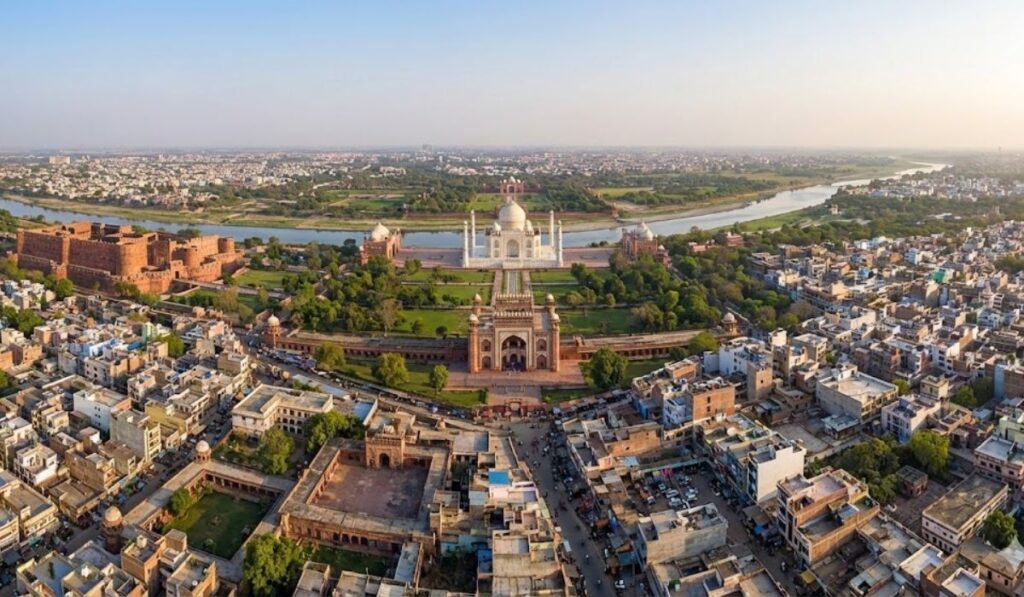
Agra suffers from a misconception: that it is a one-monument town. This view misses the city’s real depth. Agra possesses cultural density that rewards visitors who linger.
Agra Fort is a UNESCO World Heritage site in its own right. This red sandstone fortress contains palaces, audience halls, and the tower where legend says Shah Jahan spent his final years gazing at the Taj. It is essential context.
Itmad-ud-Daulah’s Tomb is often called the “Baby Taj,” but this nickname undersells its importance. It was the first Mughal structure built entirely of white marble and the first to use pietra dura extensively. It is the direct prototype for the Taj Mahal.
Craft Traditions survive in Agra’s workshops. Families have practiced marble inlay for generations. Watching them work deepens appreciation for the craftsmanship behind the main attraction.
Kinari Bazar offers an authentic experience of Indian commerce. Taking an Agra Walking Tour through this market reveals the city’s living culture, far from the manicured gardens of the famous monument.
Integration into Broader India Tour Packages
Understanding Agra’s role is essential for constructing coherent India tour packages. It is not just a stop; it is the keystone of North Indian itineraries.
Geographically, Agra sits approximately 200 kilometers from Delhi and 240 kilometers from Jaipur. This central position makes it the perfect midpoint. But its importance is more than geographic. The Taj Mahal is the primary motivator for many travelers choosing India. By placing it early, you honor that motivation. You deliver on the core promise upfront.
Tour operators like Emperor Holidays structure their North India offerings around this logic. They understand that sequence matters as much as destinations. An intelligently sequenced trip feels effortless. A randomly sequenced trip feels disjointed. Agra, placed correctly, creates flow.
When the Taj Mahal Is Not the First Stop
Any credible analysis must acknowledge exceptions. The Taj-first strategy is optimal for generalist first-time visitors, but not universal.
- The High-Altitude Trekker: If your goal is trekking in Ladakh or Himachal, beginning in Agra’s heat makes no sense. You would fly directly to the mountains.
- The South India Explorer: If your interests lie in Tamil Nadu’s temples or Goa’s beaches, North India is a detour. You would fly into Chennai, Bengaluru, or Mumbai.
- The Dedicated Spiritual Seeker: If you are coming for extended meditation in Rishikesh or immersion in Varanasi, the structured monument experience may feel tangential.
For these travelers, the Taj Mahal might be a later addition or omission. But for the majority seeking a representative introduction to iconic India, starting with Agra remains the most logical choice.
FAQ: Answering Your Questions About Visiting the Taj Mahal
1. Is sunrise really the best time to visit the Taj Mahal?
Yes, sunrise is widely considered the best time. The soft morning light creates beautiful color shifts on the marble, and crowds are significantly thinner. A Taj Mahal Sunrise Tour is the optimal way to experience the monument.
2. What day is the Taj Mahal closed?
The Taj Mahal is closed to all visitors on Fridays, as the mosque inside is used for prayers.
3. Can I realistically do a Same Day Agra Tour from Delhi?
Yes. The Yamuna Expressway makes the drive about three hours each way, and the Gatimaan Express train does it in under two. Expect an early start and late return.
4. What should I bring to the Taj Mahal?
Bring comfortable walking shoes, a hat, sunglasses, and sunscreen. Leave large backpacks, tripods, and food at your hotel, as they are not allowed inside.
5. Is one night in Agra enough?
Yes. One night allows sunrise at the Taj, exploration of Agra Fort, and perhaps the “Baby Taj.” A second night enables deeper immersion.
6. What is the Golden Triangle Tour?
The Golden Triangle Tour is the classic North India circuit connecting Delhi, Agra, and Jaipur, each rich in historical significance.
7. What else is worth seeing in Agra?
The Agra Fort is essential. Itmad-ud-Daulah’s Tomb is highly recommended. For a river-view perspective, visit Mehtab Bagh in late afternoon.
8. Is it safe to explore Agra’s markets independently?
Generally yes, but remain aware. For a richer experience, consider a guided Agra Walking Tour with a local expert.
9. Why does starting with the Taj Mahal improve my trip?
It serves as a cognitive anchor, reducing planning overwhelm. Its accessibility builds momentum, and its emotional impact builds confidence for the journey ahead.
10. Are Taj Mahal tours suitable for all types of travelers?
Yes. The site appeals to architecture lovers, history enthusiasts, photographers, luxury travelers, and budget travelers alike.
Conclusion: The Strategic Case for Starting with the Taj Mahal
India rewards those who plan intelligently. The travelers who have the richest experiences are not necessarily those who stay the longest or venture the farthest. They are the ones who understand that sequence matters. They know that a well-structured journey creates momentum, builds understanding, and generates memories that endure.
The Taj Mahal is not just a destination. It is a structural decision that determines the quality of everything that follows. It anchors your itinerary. Builds your confidence. It calibrates your expectations. It trains your eye. Provides a peak experience that reframes all subsequent challenges as texture rather than trouble.
Random planning produces random results. Deliberate, structured, intelligently sequenced planning produces something else entirely—a journey that feels coherent, meaningful, and deeply satisfying. Beginning with a Taj Mahal tour is the most strategic decision a first-time traveler can make. It is not a cliché. Not a concession to tourism. It is the logical starting point for anyone who wants to understand India on its own terms.
The question is not whether to include the Taj Mahal. The question is whether you understand why it belongs at the beginning. Now you do.