Arriving in Agra: A Different Pace Than I Expected
The train from Delhi was a long, murmuring exhalation of air-conditioned air. Stepping onto the platform in Agra felt like stepping into a different kind of warmth. It wasn’t just the heat, which was present but less frantic than the city I’d left.
It was the light, a softer gold that seemed to slow things down, and the sound—not the ceaseless orchestral honking of Delhi, but a more scattered, conversational hum.
I’d braced myself for another overwhelming sensory barrage, but Agra, at least in that first hour, met me with a kind of weary, dusty calm. The auto-rickshaw ride to my guesthouse was a series of wide, tree-lined avenues and sudden, vibrant market corners, but there was a rhythm to it I could follow.
My mind, which had been tightly wound for days, simply unfurled a little. The cognitive load, as I thought of it later, lightened. Here was a city that seemed to know its own purpose, and that purpose wasn’t to stun the newcomer, but to quietly exist around the immense fact at its heart.
I saw it in the way a shopkeeper methodically arranged his pyramids of paan leaves, utterly absorbed in his task as the world passed by.
Waiting Until Morning to See the Taj Mahal
I had the address. I could have gone straight there, dumped my bag, and joined the afternoon queue. Something in the city’s pace advised against it. A kind of respect, perhaps, or a selfish desire to stretch the anticipation.
Instead, I walked in the late afternoon, following no map, down a lane where the smell of frying spices and exhaust gave way to the faint, sweet decay of marigolds. I found a small stall with two plastic chairs, and I sat and drank chai that was too sweet and too hot.
I watched the traffic—cycles loaded with rebar, a family of four on a scooter, a wandering cow with painted horns. The Taj Mahal was a physical reality just a few kilometres away, a place I would walk to with my own feet, and knowing that, I felt no hurry.
The evening settled like a veil. This waiting felt like the most important part of the ritual. It was the deep breath before the note.
Knowing I would see it the next morning, in softer light and quieter air, made the waiting feel intentional rather than delayed — similar to what I later understood about seeing the Taj Mahal at sunrise.
The Moment the Taj Mahal Comes Into View
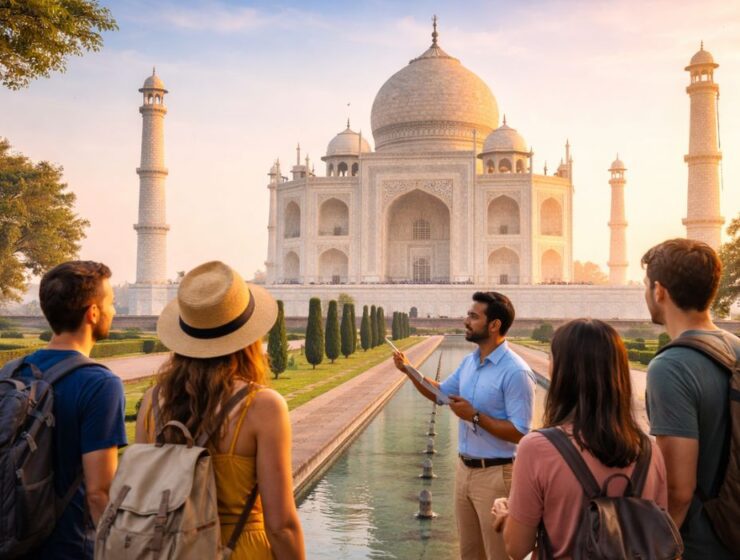
You walk through a dark, high arch of red sandstone. The crowd funnels through, a quiet, shuffling river. Then you step out, and the world opens, and it is there. No photograph prepares you for the physics of it, for the way it commands the space not with aggression but with a profound stillness.
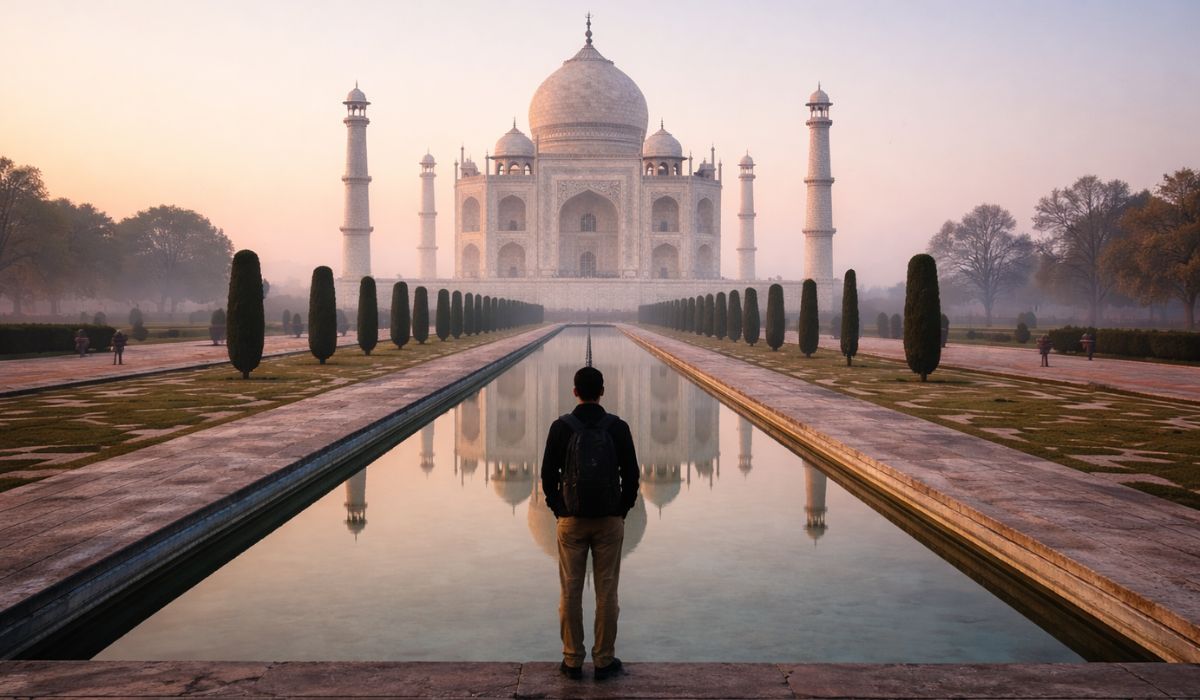
It is both lighter and more substantial than I had imagined. The first thing I saw wasn’t the dome, but its perfect, inverted reflection trembling in the long watercourse. That watery twin seemed more immediate, more alive, for a moment.
Then my eyes rose to the marble itself, the colour of a pearl in that morning light, not pure white but holding within it the soft blues of the sky and the warm blush of the rising sun. The silence around me was palpable, a shared, breath-held thing. People spoke in whispers, if they spoke at all.
The scale was human, yet incomprehensible. Every photograph flattens it into an icon; reality gives it weight, shadow, breath. It isn’t just beautiful. It is present.
Understanding Agra Through the Fort
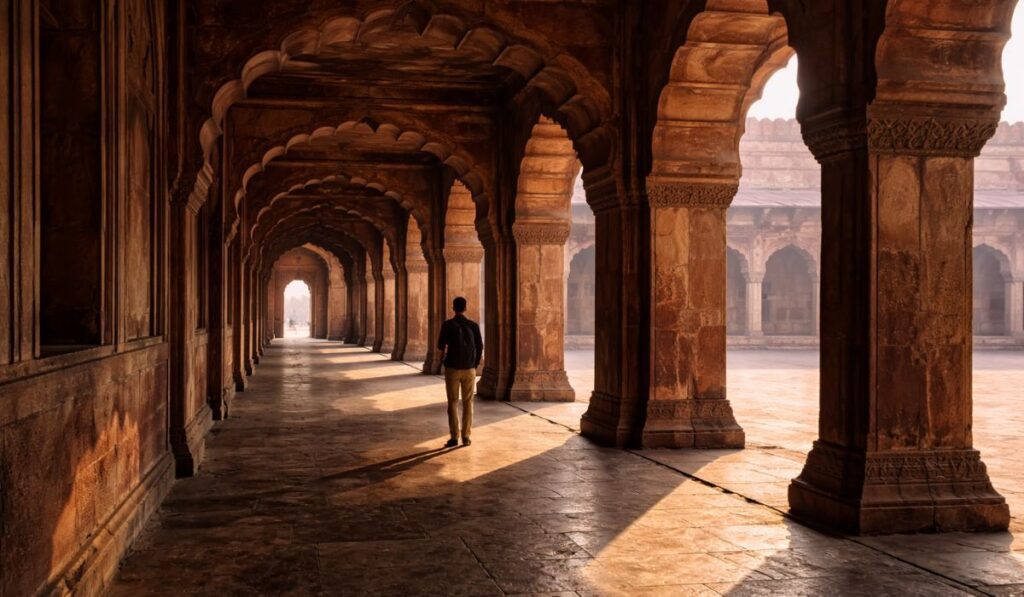
I went to the Agra Fort in the afternoon, when the light was harsh and the emotion from the morning needed a counterpoint. If the Taj is a sigh in marble, the fort is a clenched fist of sandstone.
Walking its ramparts, through halls of public audience and private, echoing chambers, I felt a different kind of awe—one tinged with the claustrophobia of power.
The history was in the texture: the coolness of the stone under my palm, the geometric precision of the inlay work, the narrow slits in the walls framing tiny, vital pictures of the city below.
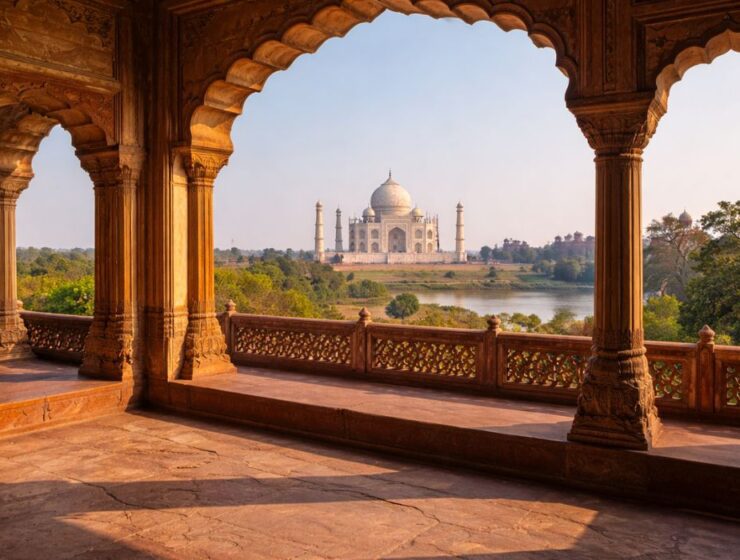
Then, from a shaded balcony, I saw it again: the Taj, small and distant from this angle, a delicate white bookmark on the horizon. From here, it looked like a dream seen from a waking state. That was the profound conversation between the two sites.
One, a monument to love, built in memory. The other, a monument to empire, built for living. One reaches outward, the other turns inward. Seeing the Taj from the fort’s stern perspective didn’t diminish its beauty; it deepened its story into something melancholic and human.
A Quieter Morning at Itimad-ud-Daulah
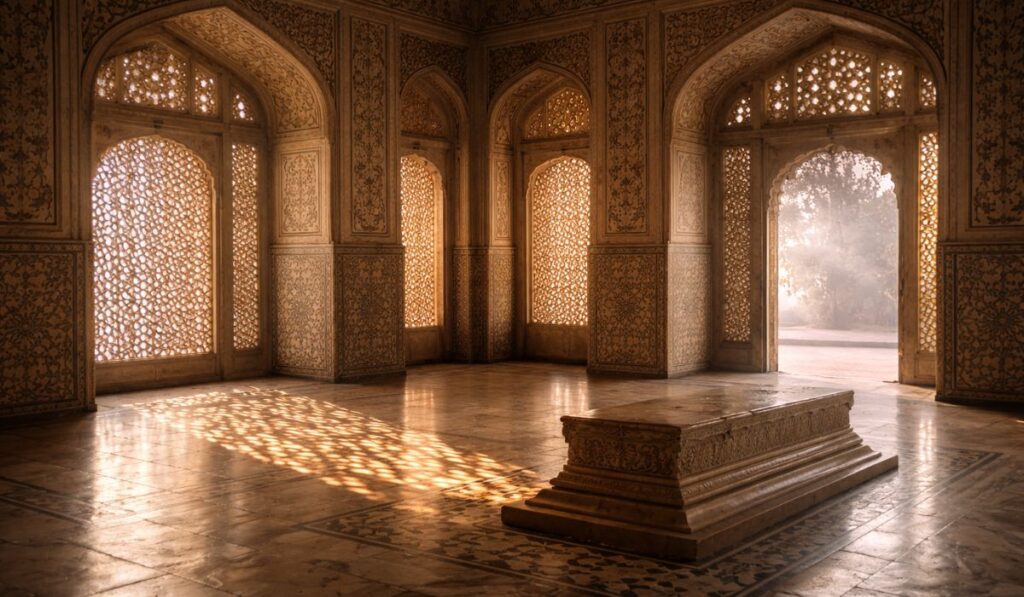
The next morning, I went to a smaller marble tomb across the river. Itimad-ud-Daulah. There were perhaps ten other people in the gardens. The silence here was different—not the held-breath hush of the main site, but a gentle, garden quiet, broken by birdcall and the distant putter of a boat on the Yamuna.
The tomb, with its intricate, lace-like marble screens and tiny, perfect inlay, felt intimate. I sat on a low wall in the dappled shade for a long time, just looking. A gardener swept leaves with a slow, rhythmic swish.
Two squirrels chased each other up a cypress tree. Without the weight of expectation, I noticed the details: the warmth of the marble where the sun touched it, the coolness where it was shaded, the way the light pierced the jali screens to cast moving constellations on the floor inside.
This wasn’t a moment of grandeur, but of grace. It mattered because it asked for nothing. It was simply there, beautiful and complete, and it let me be.
Why Agra Feels Complete, Even in a Short Visit
In three days, I didn’t see everything. I didn’t try. Yet, leaving, I felt no nagging sense of missed boxes. Agra has a rhythm that, once you surrender to it, creates a strange clarity. The monumental moments—the gasp at the archway, the fortress view—are balanced by the interstitial ones: the chai stall, the evening walk, the quiet garden.
The city itself, in the spaces between its world-famous stones, is ordinary life, relentless and vibrant.
The sites speak to each other so clearly that you understand one better for having seen the other. They form a triangle of emotion on the map: love, power, and the gentle, familial affection of the smaller tomb. Together, they tell a story more nuanced than any single guidebook entry. You leave feeling you have grasped a whole, a condensed essence of something vast, and that is a rare gift for a short trip.
What Stayed With Me After Leaving
Weeks later, back in the grey damp of England, it isn’t the facts that return. It’s the sensory inkling of the place. The specific warmth of the morning sun on my neck as I stood still by the water. The gritty feel of red sandstone dust on my fingertips after trailing them along a fort wall.
The taste of that too-sweet chai. The visual echo of that perfect reflection, constantly dissolving and re-forming. More than anything, it’s the emotional aftertaste: a layered feeling of awe that had room in it for melancholy, for peace, and for a profound sense of human scale. The memory isn’t a postcard; it’s a composite of light, texture, and a quiet mind.
Final Reflection
I went to Agra to see a building. I left having felt a quiet dialogue between stone and sky, power and loss, the monumental and the minute. The reward wasn’t in checking a sight off a list, but in the slow settling of the experience into my own memory, where it continues to mean something subtle and personal.
The Taj Mahal is not a destination. It is the centre of a quiet, powerful field of gravity, and for a few days, I orbited within it.
Written by Daniel Foster
(Guest travel experience shared via Emperor Holidays)
Daniel Foster is a UK-based traveler visiting India for the first time. He explored Agra as part of a short Golden Triangle journey arranged through Emperor Holidays. This blog reflects his personal, on-ground experience in Agra, capturing how the city felt in real time—from navigating historic spaces to absorbing the emotional impact of seeing the Taj Mahal for the first time.
The views shared are personal observations and are not promotional in nature.